
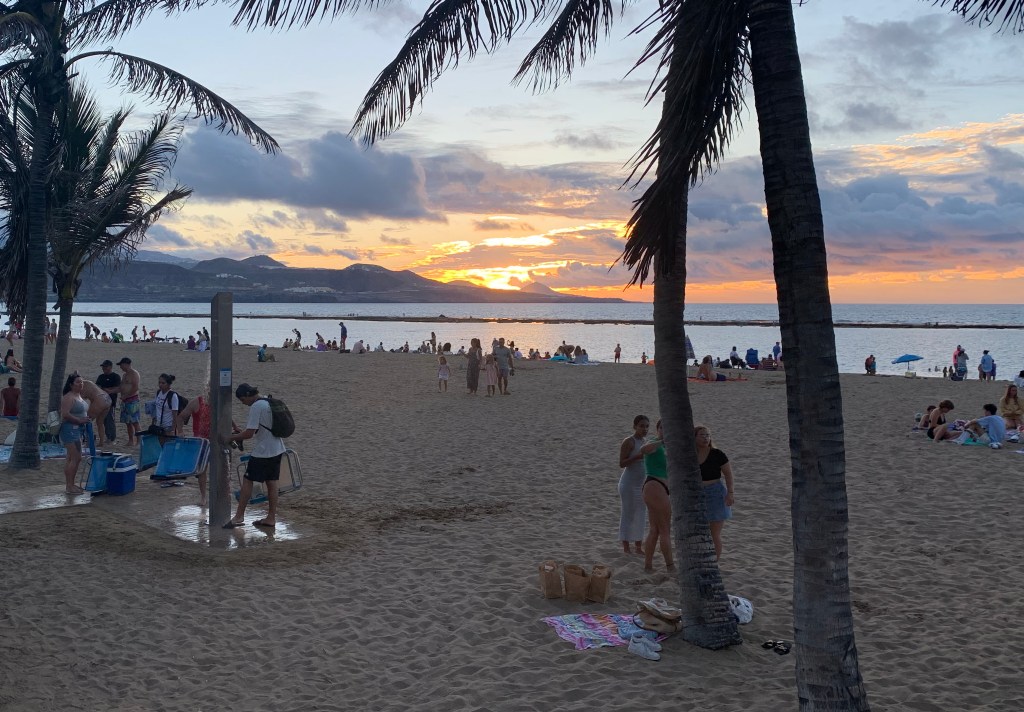
Back in Gran Canaria, I went for a swim at Las Canteras last week. After a summer of swimming in the local pool in Montreal, staring at the black line while doing my laps, it was refreshing to see a changing environment below me – wavy green grass, fish, coral, all the “natural” things. And of course, the taste of the water and the gentle motion of the surf bring a different experience to my long-distance swimming.
In the pool I am used to 25 or 50m lengths followed by a flip-turn, then repeat. The entire workout is pre-calculated and broken down into “laps” – this many laps at this pace doing this stroke. The actual swimming process is almost forgotten as the focus is more on technique, time, all the other variables. But open water swimming is a different beast, with additional variables thrown in. How far will I go before turning around? Am I swimming in a straight line? Is the current pushing me off my expected trajectory? Will I get distracted by the cool still life and wildlife below me? The extent of my workout is often decided by the current conditions – weather, high/low tide, even sometimes the amount of “traffic” in the form of other swimmers crossing my path or simply people enjoying a day at the beach.
I’ve done a few races that begin with a pool swim, but most of them are done in an open water area, either a river, a lake, or the ocean. Sometimes murky, sometimes crystal clear, sometimes full of plants that hamper every stroke. A key to the swim segment of racing is to have previous experience with all these variables (along with the pool skills) so that there is no additional panic during the swim. The swim section of a race is already stressful enough with the human element flailing away around you, best to keep other new sensory input to a possible minimum. This means open water swimming under non-optimal conditions on a regular basis.
I’m not saying it will always be a fun experience, this training in non-idyllic situations, but just keep telling yourself that it will be a great experience to think about… after it is over. As usual, it will always seem much worse while you are in the water – the waves are extra high, the current is extra strong, the water so murky and churned up that each stroke is an effort. And as usual, by the time you exit and look back on the area where you were swimming, it doesn’t look that bad – actually, kind of nice and placid now, look at all those other swimmers, no problem really with the conditions today.
Part of Las Canteras was closed for a few days recently, as there was a bacterial infestation found during regular water check-ups. Nothing too bad, and not in the area where I usually swim, but hey, why risk it? Also, there were hammerhead shark sightings just off the beach over two consecutive days. These were several variables too much for me, so I decided to concentrate on the dryland portion of training for the week until the excitement died down. No worries, after a few days all was good. During a swim recently the police helicopter overhead slowly patrolling the reef was just a precaution, no more reports of shark sightings. Back to business, back to my acceptable variables.
 Tridiabet