
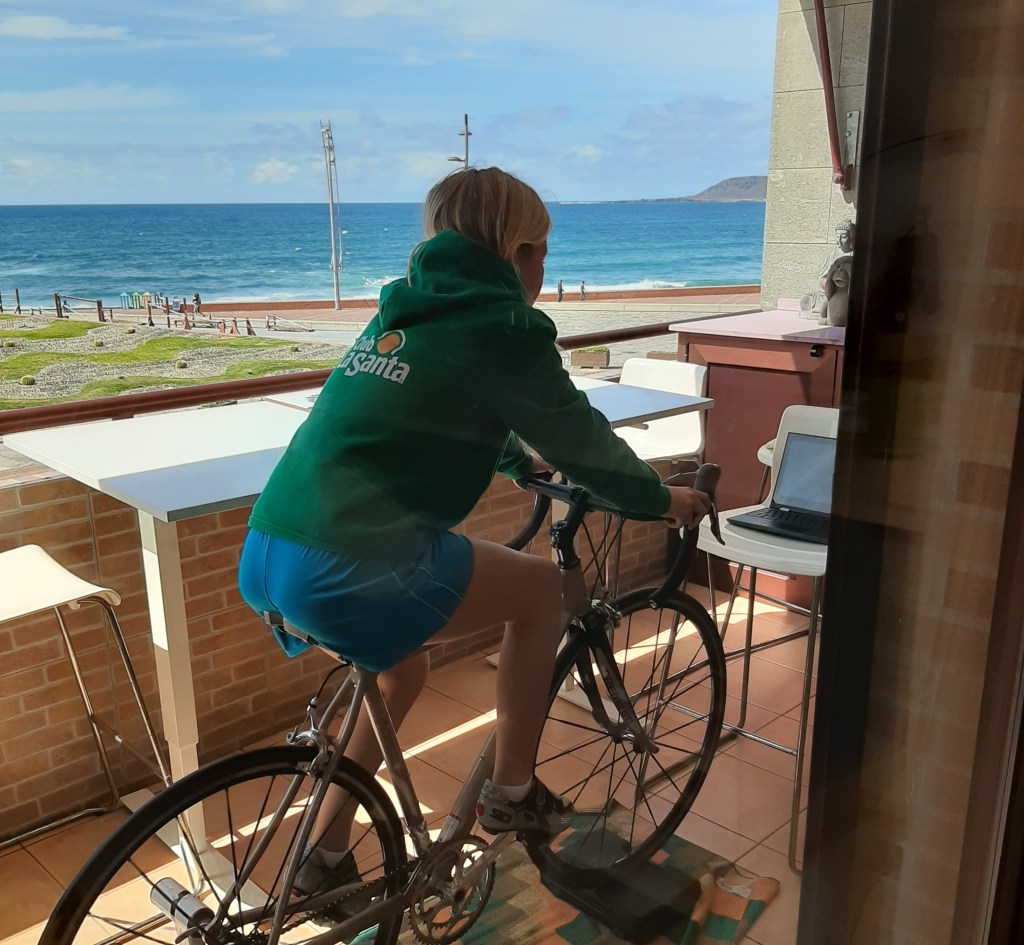
The Canary Islands are a beautiful place to live and train. But in the early days of Covid-19 Spain was a tough place to be, as we had, I think, the strictest confinement measures imaginable. No leaving the house other than for groceries or to take out the trash. No outdoor exercise. No outdoor anything. My daughter didn’t leave our apartment for weeks. I had a bike trainer which I setup on the balcony, and we all used it. Myself, my wife, and my daughter. Oh, did I forget to mention that we had recently moved into a small apartment just next to the beach? By “just next to the beach,” I mean we could walk out our front door in a bathing suit, walk about 100 meters, and jump in the water. It was right there, so close. But during those confinement days the beach was pristine and empty every day, just out of reach. It looked great from our balcony as we sweated away on the trainer.
I began to notice that I couldn’t keep going for the same amount of time on the trainer, it was too tiring. I was tired a lot, as I wasn’t sleeping very well. I always seemed thirsty, I was losing weight, and I was going to the bathroom all the time. At one point it got so bad that I finally agreed with my wife and went to the emergency room. My weight had dropped to about 145 pounds, and I was in my wife’s words a “walking skeleton,” even though I was drinking water all the time. After a blood test at the hospital, I immediately was sent to the ICU, where they pumped me full of saline solution over the next few days. They also started giving me insulin injections to bring my sugar levels back down. This was interesting, as I had never had an insulin injection before.
Let me back up. In 2012 I was diagnosed with Type 2 diabetes, which I found odd since I ate well and exercised incessantly. But hey, the doctors must know what they are talking about, right? They started me on Janumet and things went well for a while, like years. But when we moved to Gran Canaria in 2018 I no longer had my twice-yearly checkups as I didn’t have a local doctor. But hey, things are going well. Except they weren’t. Things had been gradually going downhill for a while, but I didn’t really notice it as I was still eating well and getting plenty of exercise. Until I wasn’t. Then things crashed hard. So, at least for me, the Spanish total confinement brought to a head my downward plunge and made it obvious to everyone, including me.
It turns out that they got the diagnosis wrong back in 2012. Type 2 is the common diagnosis, and then there is Type 1 which is usually diagnosed at a young age and requires regular insulin doses along with other medication. But there is a third type of diabetes, even more rare than Type 1. It is called LADA, or Latent Autoimmune Diabetes in Adults. Essentially it is Type 1.5. It usually hits around age 40 and starts out looking like Type 2, and is treated by medication such as Janumet. But at some point, the pancreas starts to fail and then it begins to look more like Type 1, with the regular need for insulin along with other medications such as Janumet. I had held off this metamorphosis for a long time due to my healthy habits, but the sudden stoppage all most things sporty had triggered my now regular need for insulin. And as I had no idea at the time, things went downhill fast.
I thought (just before going to the hospital) that I was doing things right, taking care of myself, and a little more sleep would make it all better. Not even close. So, I’m in the ICU being pumped full of saline and getting regular shots of insulin. Almost immediately I am feeling better, but most importantly I can sleep for a few hours at a time because I don’t have to constantly go to the bathroom. So after three days in the ICU I am stable enough to move to a regular room on another floor of the hospital.
I spent five days in that other room, endured regular blood tests and insulin injections and medications while the doctors found the best mix to keep my sugar levels stable. That is when they explained what had happened and introduced me to the term LADA. I started getting used to my now regular need for insulin injections along with my medications. Upon leaving the hospital I began again with appointments and blood tests every 5-6 months to make sure everything progresses correctly. I did a bit of research on CGMs (continuous glucose monitors), discussed them with my specialist, and settled on the FreeStyle Libre system, thus saving my fingertips from 10-15 jabs per day.
It was a scary time for me and for my family. I felt that things were so out of my control and that is not a feeling that I like. I’m glad my wife convinced me to finally go to the hospital and let the professionals figure out my issues. Well, my medical issues at least. The rest of my issues are for me alone to fix.
 Tridiabet