
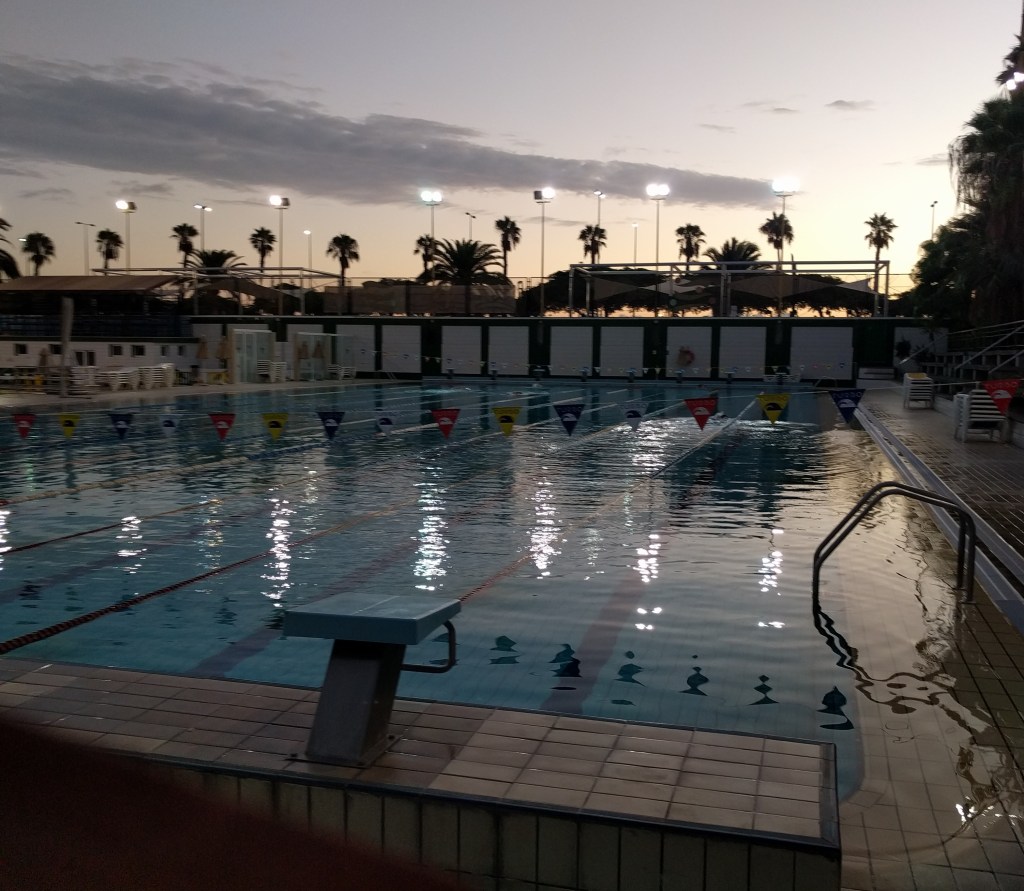
The life of most triathletes is full of training – in the pool, on the trainer, on the treadmill – for those winter months when Mother Nature ceases to accommodate our athletic addiction. Lane swimming is great for training, allowing coherent structure and timing over a fixed distance. Great. Except if, like me, you wear a CGM (Continuous Glucose Monitor) sensor like my FreeStyle Libre. By itself the device does what I want it to do, making it quite simple to check my glucose levels (and less painful as the dreaded finger-pricking no longer makes my fingertips numb). But there is a catch, and I mean that literally. Lane buoys.
You know, those floating sets of buoys that mark different lanes? In the pool where I train there are, I think, eight lanes, with 50 meters of lane buoys between them. Wonderful, high-tech lines that keep down the waves between the lanes, have color differentiation at different intervals to know where you are in the pool… and are a nightmare for people like me.
Let me back up a bit. My CGM sensor is basically a round piece of plastic about 30mm across and roughly 5mm thick. It contains a small needle and some Bluetooth magic so that I can read my glucose levels using a smartphone app. Cool. It is held on by some adhesive backing and is unaffected by showers, pool swimming, sweat, etc. Still cool. They cost about 50 euros per sensor and last for two weeks. OK, that part is not so cool, but I can live with it.
Remember those lane lines I mentioned, with that neat row of miniature buoys? Well, they can become a serious problem when you wear a CGM on the back of your upper arm (where they are supposed to be worn). Especially when you are in a crowded lane, people going in both directions at full speed, and you have to move closer to the lane line to give each other room (usually when multiple people are in a single pool lane you swim in a counter-clockwise motion, so there is usually a lane line just to the right of you). Sometimes you brush up against the line depending upon how far over the person is going in the opposite direction. While doing the crawl, this is not such a big deal, as you can see what’s coming. But if you are doing backstroke, and you need to move just a bit closer to the lane line, and you happen to be wearing your CGM on your left arm during this two-week period… its like those lane markers were custom designed to rip the CGM right off your arm! Bang! There goes 50 euros. Hopefully it happens near the end of the 14-day lifecycle… actually, hopefully it doesn’t happen at all, but ideally it happens late in the CGM sensor lifecycle. In the past year this has happened only twice, and each time I only had a few days left in the sensor, but it is something I worry about each time I do a pool workout with the team. Will I momentarily daydream in the middle of a set (this happens quite a bit during some of the longer sets) and drift too close to the hungry lane markers? How many days do I have left on this CGM? Wait a minute, where am I in the set again? Are we almost finished? I think someone is getting close even though I cannot see them because I am on my back looking straight up while trying to avoid high-speed oncoming traffic… Are we done yet? Yes, all right, great, still attached! Made it through another day.
I guess you can look at it as another aspect of training – dealing with the anxiety and the stress while competently completing the training block. A large part of triathlon training is in your head, anyway. And, apparently, on your arm.
 Tridiabet